
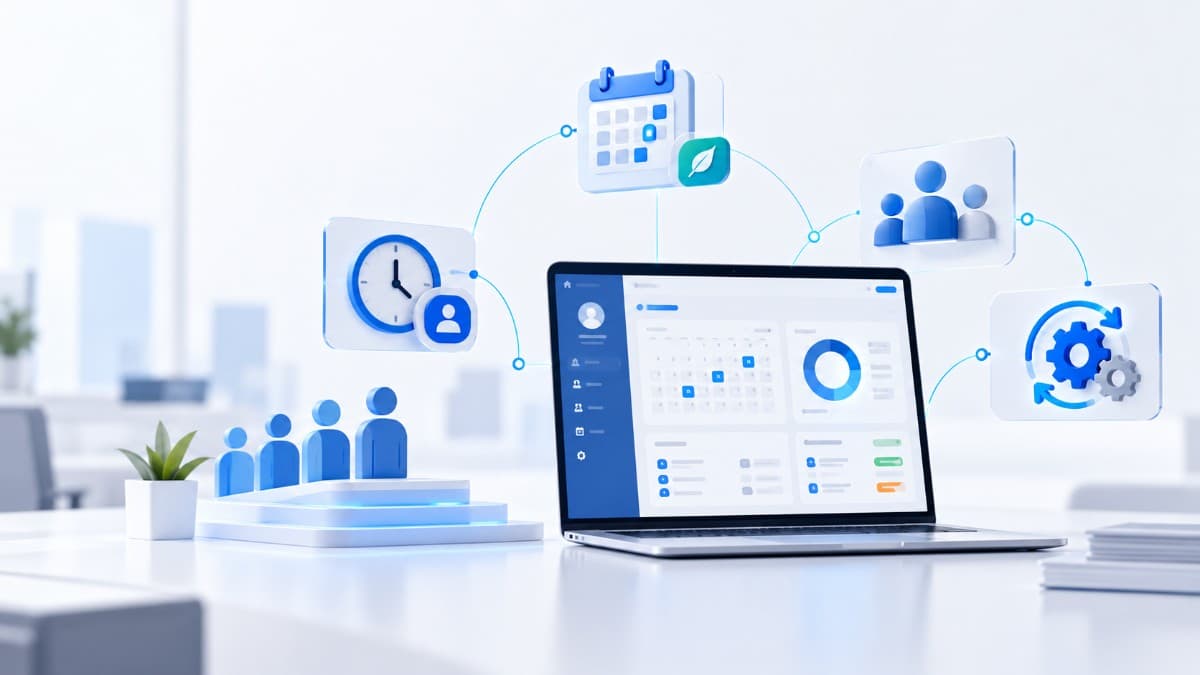
Explore our HRMS development case study featuring role-based access, shift and roster management, attendance automation, leave workflows, compensatory time off and auditable regularization.
A connected employee, manager and administration platform built around the organization's reporting hierarchy, shift rules, leave policies and approval workflows.
| Engagement | Details |
|---|---|
| Client | Organization with a structured, multi-role workforce |
| Solution | Peopleix HRMS: employee lifecycle, attendance, leave and Comp-Off platform |
| Channels | Web application for employees, managers and administrators, with automated email notifications |
| Platforms | Web |
| Modules | Organization and employee records, shifts and rosters, attendance, breaks, regularization, leave, holidays, Comp-Off |
A Unified HRMS for Attendance, Leave and Workforce Automation
Growing organizations often run HR on a mix of spreadsheets, email approvals and manual attendance calculations. Peopleix brings employee records, shift planning, attendance, breaks, regularization, leave and compensatory time off into one Human Resource Management System, with configurable rules applied consistently and every key attendance correction retained in an audit trail.
About the Client
The client is an organization with a structured workforce spread across departments and reporting lines, from leadership roles such as the CEO and CTO through managers and team leads to employees and interns. Work patterns vary: standard shifts, flexible schedules, night shifts that cross midnight and shifts that allow multiple sessions in a day.
The organization needed one system that reflected this structure, kept employee information in a single place and applied its attendance and leave policies without manual calculation or repeated follow-up between employees, managers and HR.
Overview
As headcount and policy complexity grow, HR teams spend more time reconciling punch times, chasing approvals and recalculating leave balances than supporting people. Accurate attendance depends on shift rules, grace periods, holidays and approved leave all being evaluated together, and any change must be traceable.
Peopleix was designed as one platform with role-based access and a validated reporting hierarchy. Employees punch in and out, record breaks, request leave and raise attendance corrections. Managers and administrators review and approve requests. Organization administrators configure shifts, rosters, leave policies, holidays and Comp-Off rules. A background automation layer keeps attendance records, leave balances and notifications up to date.
Challenges
1. Fragmented employee and organization records. Employee details, departments, reporting relationships and statutory information needed to live in one controlled system rather than across separate files.
2. Varied working patterns. Standard, flexible, overnight and multiple-session shifts each need different attendance rules, with weekly rosters that can assign a different shift to each day.
3. Manual attendance calculation. Late arrivals, half days, early logouts, overtime and holidays had to be evaluated consistently against configured grace periods and working-hour thresholds.
4. Missed and inaccurate punches. Employees needed a structured, auditable way to correct attendance, with supporting proof and a clear approval path.
5. Complex leave administration. Entitlements, accruals, probation restrictions, notice periods, overlapping requests and balances had to be validated and tracked without manual effort.
6. Hierarchy-based approvals and timely communication. Requests needed to reach the right manager or administrator, and everyone involved needed to be informed of each decision.
Solution
1. Role-based access and organizational structure. Peopleix supports eight roles, from Super Admin and Organization Admin to Manager, Team Lead, Employee and Intern. Reporting relationships are validated, circular reporting chains are prevented, and assigning an employee as a department manager can automatically promote their role to Manager.
2. Complete employee records and lifecycle control. Profiles hold personal and contact details, employment information, reporting lines, emergency contacts, statutory identifiers and bank information, with photos and supporting documents stored in cloud storage. An employee's leaving date controls access, blocking actions such as punching in, starting breaks and submitting leave once it takes effect. Administrators can reactivate an employee where appropriate.
3. Configurable shifts and weekly rosters. Shifts define start and end times, late-arrival grace periods, minimum hours for a full day, overtime thresholds and half-day cutoffs, with support for night, flexible and multiple-session shifts. Attendance records keep a snapshot of the shift settings used at the time, so later configuration changes do not rewrite history.
4. Automated attendance and break management. Punch In and Punch Out sessions are validated against the employee's status, assigned shift and holiday calendar. The attendance engine assigns statuses such as Present, Late, Half Day, Absent, Early Logout, On Leave and Holiday or Week-Off. Lunch, Tea and Other breaks follow policy limits, open breaks are closed automatically at punch-out, and breaks that exceed the configured threshold are routed for approval.
5. Auditable attendance regularization. Employees request corrections with the required punch times, a reason and supporting documents within a 30-day submission window. Approvers are notified by email, can approve, reject or revert the request, and approved changes trigger recalculation and are recorded in the audit trail.
6. Policy-driven leave management. Employees request leave by type, date range and, where allowed, half-day session. The system validates probation rules, notice periods, duration limits, attachments, overlaps and available balance. Pending, used and available days are tracked separately, and approved leave is synchronized to attendance as On Leave or Half Day.
7. Leave policies, AutoCredit and holiday calendars. Annual allocation and monthly or quarterly accrual support carry-forward, probation-related delays and maximum accumulation limits. Holiday calendars are evaluated by country and shift, and floater holidays give employees optional days off according to policy.
8. Compensatory off. Eligible work on public holidays or week-offs, or qualifying extra hours, can generate Comp-Off credits. Credits are tracked individually with amount, usage and expiry, are consumed oldest first, and can be marked for encashment where hybrid mode is enabled.
9. Notifications and background automation. Responsive HTML emails cover password resets, leave and regularization submissions and decisions, and missed-punch alerts with a link to submit a correction. Scheduled processes generate missing attendance records, apply approved leave to earlier dates, send missed-punch alerts, provision balances for new policies and process expired Comp-Off credits.
10. Security and data handling. JWT-based authentication, password hashing, role-based access checks and time-limited password reset tokens protect day-to-day use. Branding, profile photos and supporting documents are stored in AWS S3.
Impact
1. One source of truth for workforce data. Employee, organization, shift, attendance and leave records sit in a single platform with consistent access rules.
2. Consistent policy application. Grace periods, half-day cutoffs, overtime thresholds, break limits and leave rules are applied by the system instead of being calculated by hand.
3. Less manual administration. Automated attendance generation, leave synchronization, balance provisioning and missed-punch alerts reduce routine HR follow-up.
4. Clear and accountable approvals. Requests reach the configured manager or administrator, and attendance corrections are retained in an audit trail with remarks and supporting proof.
5. A better employee experience. Employees can punch in and out, request leave, correct attendance and see decisions through one self-service experience with timely email updates.
· Flexibility across working patterns. Standard, flexible, night and multiple-session shifts are supported within one attendance engine.
Technology Stack
| Layer | Technology | Purpose |
|---|---|---|
| Application framework | Next.js (App Router) with API route handlers | Web application and backend APIs |
| Programming language | TypeScript | Type-safe application development |
| Database | MongoDB | System of record for employees, shifts, attendance, leave and Comp-Off |
| Data access | Prisma Client | Structured access to application data |
| Authentication | JWT and bcrypt | Secure sign-in and password hashing |
| File and image storage | Amazon Web Services (AWS) S3 | Branding, profile photos and supporting documents |
| Email delivery | Nodemailer with responsive HTML templates | Workflow notifications and alerts |
| Time zone handling | Asia/Kolkata (IST) | Consistent attendance and scheduling calculations |
Results
Peopleix gives the organization a shared operational foundation for employees, managers, team leads and administrators across the full attendance and leave lifecycle.
1. Eight roles with a validated reporting hierarchy. Access and approval authority follow the organization's structure, with circular reporting prevented.
2. End-to-end digital attendance. Punch-in, breaks, punch-out, status calculation, overtime and Comp-Off evaluation are handled within one platform.
3. Auditable corrections. Regularization requests support a 30-day submission window, proof uploads, approver reversion and a recorded audit trail.
4. Automated leave lifecycle. Requests, approvals, balance updates, accruals and attendance synchronization run through one workflow.
5. Proactive automation. Background processes backfill attendance, flag missed punches, provision new leave balances and process expired Comp-Off credits.
Conclusion
Peopleix gives the organization a structured digital foundation for managing its workforce. Employee records, shifts, attendance, regularization, leave and compensatory time off now work together, so organization-defined rules are applied consistently, the right people are notified, and key attendance corrections are traceable.
The result is a practical HR platform that reduces manual calculation and follow-up, gives employees and managers clarity, and can be tuned to the organization's own policies as it grows.
Planning an HR or workforce platform that must reflect your shift patterns, leave policies and approval workflows? Talk to the Vionsys team about product strategy, web application development, workflow automation and cloud delivery.