

Agentic AI is changing the face of robotics by equipping systems with the ability to self-govern rather than follow fixed directions. The robots are no longer bound by the rules laid down in advance; they can weigh the options, make the decision, and act towards achieving the given goals. The change is allowing automation to operate efficiently in volatile surroundings where there is constant change, uncertainty, and large numbers.
Rule-Based Automation to Agentic AI Systems
Traditional automation is very much dependent on the logic that has been set in advance. Ones actions are entirely based on a fixed rule or the instruction of a pre-written program. The method is effective in controlled environments only and is not reliable when the situations are altered. Agentic AI revolutionizes the way we work in that it replaces the old system of fixed rules with new ones that target goals instead of commands.
With robot technology, the implication is that the machines no longer have to be hardwired to carry out a certain task. Robots not only can they evaluate the situation, but they also decide the suitable course of action given the most recent context and can even change their behavior if new conditions arise. Incomplete and unpredictable inputs are among the scenarios where the robots can still perform efficiently.
Decision-Making as a Core Capability
Agentic AI has decision-making implanted directly into the DNA of the system. Robots in an exception scenario do not have to depend on a human to intervene; instead, they review what options exist and pick the one that is the most effective.
This capability allows automated systems to deal with real-time constraints which could be shifting workloads, physical obstacles, or even unforeseen failures. Gradually, these systems become more efficient as every decision they make paves the way for better future results.
Moving Beyond Centralized Control with Agentic AI in Robotic Coordination
In cases of intricate surroundings, one central control becomes the major problem of bottlenecks. With the help of Agentic AI numerous robotic units can be turned into independent agents who concurrently coordinate with each other. Each agent is aware of its function but based on the conduct of the others can change accordingly.
The model is a pledge to the systems resilience. While one unit is dealing with the problem, the others are adjusting without the overall operations getting interrupted. Automation, in turn, is getting distributed, becoming more flexible, and easy to scale.
Learning Through Interaction & Continuous Adaptation in Live Environments
Traditional robotic systems have to be retrained or reprogrammed if their tasks change. Unlike them, Agentic AI systems gain knowledge through interaction. They take in the information, adjust decision paths, and implement the learning in coming scenarios.
The method is less dependent on the time of the break and thus allows the automation systems to keep on getting better while still being up and running. Moreover, it lessens the long-term cost of maintaining complex robotic environments.
Human-Robot Collaboration in Practical Settings
Agentic AI enables robots to understand the intention of humans rather than simply following the exact commands. Thus, working with humans becomes less artificial and is less dependent on structured inputs.
While sharing workspaces, robots modify their behavior to be in sync with human movement, timing, and priorities. The main benefits are safety enhancement, the elimination of the cause of friction and the facilitation of more flexible task sharing without the need for constant supervision.
Knowing Infrastructure Requirements for Agentic AI
Agentic systems are dependent on very fast decision-making loops and efficient data flow. Robots equipped with Agentic AI need to have cloud-enabled architectures together with edge computing if they are to be able to respond in real-time.
If there is no robust infrastructure, then autonomous decision-making will be unreliable. The factors of scalability, latency, and system security have a direct impact on the agentic models’ performance in production environments.
To be Concluded: Control, Security, and Accountability
Autonomy still requires control. It is imperative that Agentic AI systems function within specified limits. The decisions have to be seen, traced, and undone if it is the case that they are needed.
Safe system design guarantees that autonomy is a way to make things more reliable rather than being a potential source of risk. The governing is integrated into the structure, not as a step that comes after the deployment.
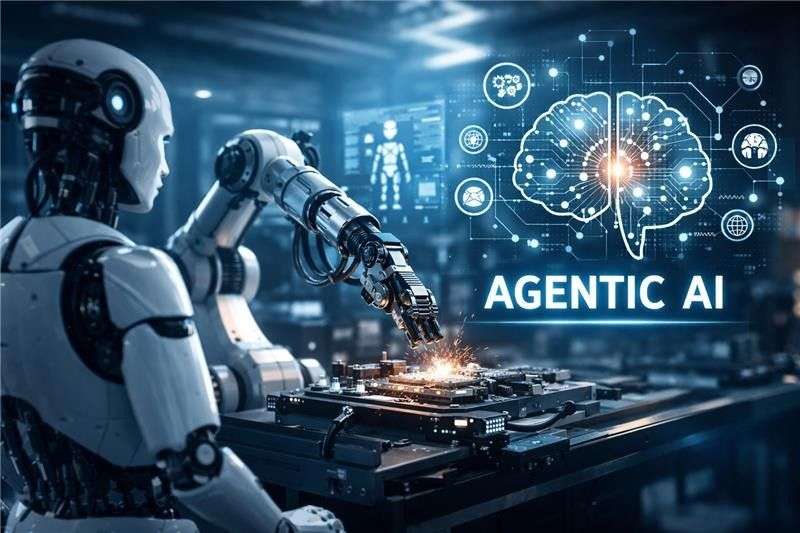
Agentic AI is doing the radical shift of the concepts behind robotics and automation from execution to decision-making. Robots are not tied to the script any longer; they are adaptive agents that can deal with complexity, change, and scale. Robotization in less predictable environments is where agentic systems will be a must if we want to have resilient, intelligent, and sustainable robotic operations.
FAQs
How is Agentic AI different from traditional automation AI?
Agentic AI evaluates the situation, then it decides on its own what to do to reach the goal without being limited by rules or a script.
Can Agentic AI be implemented in existing robotic systems?
Indeed. Moreover, the functionalities of the existing systems can be complemented.
Which industries gain the most from Agentic AI in robotics?
Manufacturing, logistics, healthcare, energy, and smart infrastructure sectors.
Is Agentic AI suitable for small or mid-scale automation?
Certainly. Deployment can be carried out in a step-by-step manner depending on the operational requirements.
What infrastructure is required for Agentic AI systems?
The architecture needs to be cloud-enabled with edge computing and data pipelines which ensure data security.
How is control maintained in autonomous robotic systems?
It is done with the help of defined decision boundaries, continuous supervision, and intervention mechanisms.
Does Agentic AI require continuous retraining?
No, as the AI adjusts itself through instant real-life interaction and learning.
What are the primary risks of adopting Agentic AI?
Those are improper architecture, lack of governance, and insufficient infrastructure.
How does Agentic AI improve humanrobot collaboration?
In fact, robots are able to grasp the environment and purpose rather than being given explicit instructions.
How can Vionsys support Agentic AI implementation?
Vionsys helps businesses achieve their goals by creating, provisioning, and maintaining securely scalable Agentic AI systems.
