


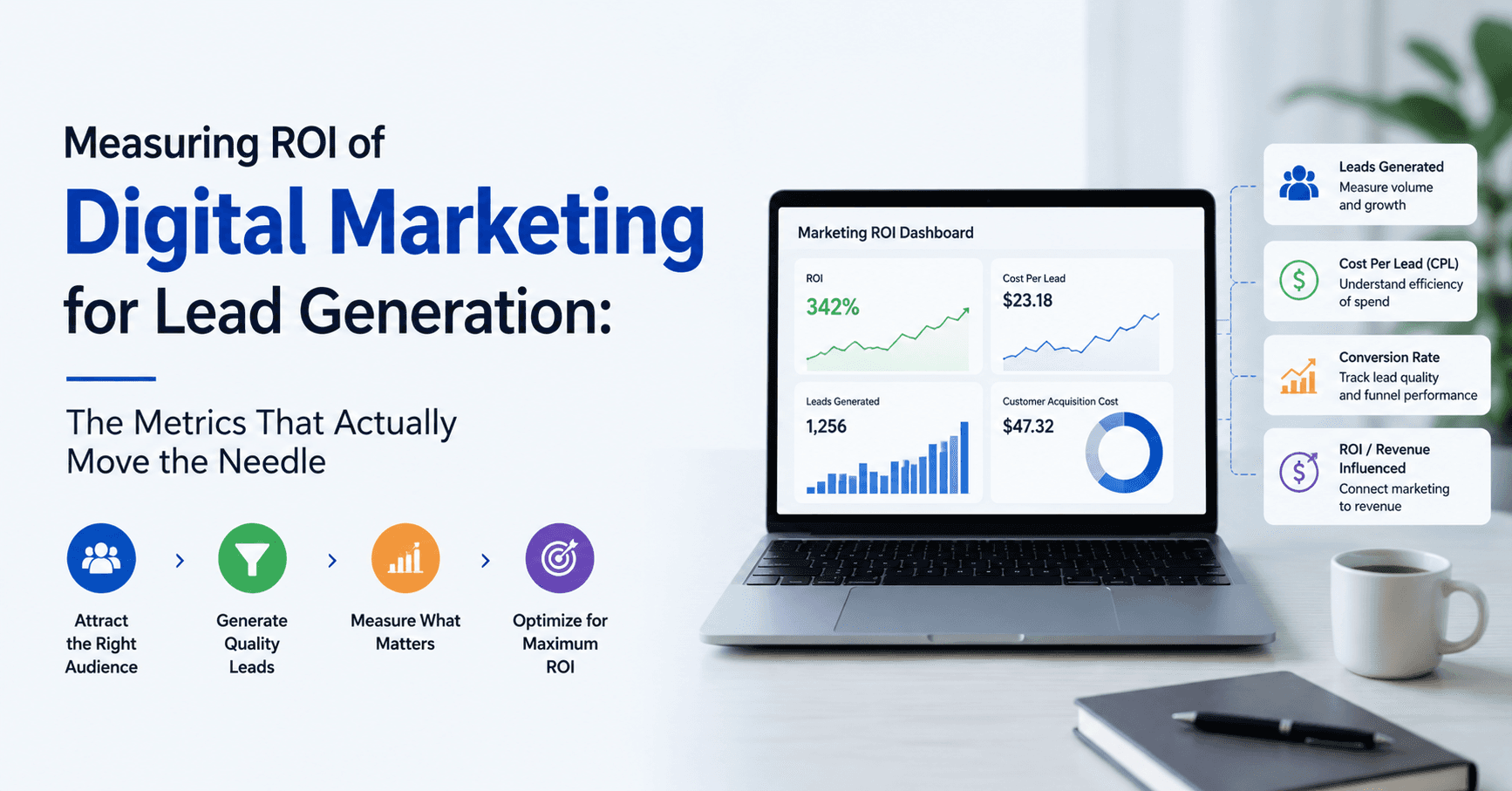
Measuring ROI of Digital Marketing for Lead Generation: The Metrics That Actually Move the Needle
Investing in digital marketing for lead generation is no longer optional, but a necessity. Though a large number of organizations have allotted massive budget for paid ads, content creation, search engine marketing campaigns, SEO, and social media ads to increase their online visibility, they have failed in answering one question:
Does digital marketing help in generating ROI?
Clicks, impressions, shares, likes, and comments can look nice on dashboards. However, they do not always convert into qualified leads. For measuring the outcomes of digital marketing activities, we use metrics such as customer acquisition cost (CAC), return on ad spend, customer retention, rate of conversion, ROI, customer lifetime value, and click-through rate (CTR). Moreover, these metrics are directly related to quality of leads, sales, and profits.
Why Measuring ROI in Digital Marketing for Lead Generation can prove to be a major challenge
Digital marketing makes use of many channels including social media ads, search ads, content, paid ads, and email. Leads cannot be converted immediately and buyers interact with many brands before making any decision. Few of the common challenges include:
· Many touchpoints across various platforms
· Long sales cycles
· Humungous reliance on vanity metrics
Why metric that measure the performance of digital marketing moves your marketing needle
Trying to perform a marketing campaign without looking at the metrics is like setting sail without a map. You may be moving, but not in a right direction. Hence, digital marketing performance metrics provides you with that crucial sense of direction. It acts as a marketing needle, guiding your strategy all the way from creating initial awareness to securing that final conversion.
In digital marketing for lead generation, success is defined not by number of leads but by rate of conversions. Hence, organizations focus on improving lead quality, conversion efficiency, and ROI generation. Measuring ROI helps firms in determining performance of digital marketing channels, minimize spending on resources that are not giving massive profits, increase rate of conversions, and aligning marketing activities with sales outcomes.
Transforming Data Into Decisions
The digital marketing metrics helps you in making data-backed decisions. Through right data tracking, you can:
· Justify Spend on Marketing Activities: Demonstrate stakeholders as how your efforts are profiting by linking ad campaigns directly to ROI.
· Improve Campaign Performance: Discover the digital marketing channels that are not performing and then allocate your budget to those channels that are delivering the results.
· Understand Your Audience: Get an apt idea of what your customers do, what are their preferences & interests, and what challenges they face. This helps you in coining a marketing strategy that genuinely connects with them.
Tracking performance metrics of digital marketing activities transforms marketing from expenditure into a measurable investment.
Building Blocks for digital marketing growth
There are different parameters for measuring the growth of your brand online. Let us discuss them:
· Determining Brand Awareness: Measuring how many of people are viewing your brand with the help of impressions, website traffic, and reach.
· Measuring Engagement Level: Know how your target audience engages with content through likes, shares, comments, and click through rates.
· Track Number of Conversions: Track actions that help you in increasing the rate of conversion by determining cost per acquisition, rate of conversion, and cost per acquisition.
Decode your search engine marketing performance
Companies want quick visibility on search engines and hence they make use of paid campaigns such as pay-per-click ads. It helps in turning leads into business and improve the performance of your digital marketing activities. Click-through rate, quality score, return on ad spend, and cost-per-click are key performance indicators of PPC ads.
Measuring your organic SEO efforts
Most SEO reports look impressive on paper traffic up, rankings improving, impressions growing. But when the sales team asks how many leads came from organic search last quarter, the room goes quiet. That gap between SEO activity and revenue proof is exactly where ROI calculation needs to start.
The first honest evaluation is organic traffic-to-lead conversion rate. Take your total organic sessions and divide by the leads generated from those sessions. Industry benchmarks sit between 1–3% for B2B. Anything below that is not an SEO problem it is a landing page or offer problem that more traffic will not fix.
Next, calculate your true cost-per-lead from organic. Add up everything content creation, technical SEO work, tools, and time then divide by qualified leads generated over a 6-month window. Most businesses are surprised to find organic CPL running 60–70% lower than paid, but only after month four or five when content starts compounding. Before that point, the numbers look unfavorable. That timing gap is what makes SEO ROI hard to defend in short-cycle budget reviews.
The evaluation most teams skip is SEO's contribution to assisted revenue. A lead that first found you through a blog post, came back via email, and then booked a demo gets attributed to email in last-click models. Organic search gets nothing. Switching to a first-touch or linear attribution model inside your CRM often reveals that SEO is influencing 30–40% more pipeline than the dashboard shows.
Finally, assess your content efficiency ratio how many of your ranking pages are actually generating leads versus just generating traffic. If 80% of your organic leads come from 20% of your content, the ROI calculation changes completely. You are not underinvesting in SEO you are overproducing content that does not convert.
That is the real measurement: not how much traffic SEO brings, but how efficiently it turns search intent into pipeline.
Measuring what matters on digital marketing channels for different Business.
The performance metrics for digital marketing for lead generation depends on the digital media channel that we select and the type of business. For instance, a B2B company and a B2C company will have completely different approaches to the digital marketing touchpoints and will react accordingly. Hence, measuring the ROI of digital marketing for lead generation differs from Business to Business.
How can I choose right metric for measuring ROI of digital marketing for lead generation.
The best way to choose correct metric for ROI measurement depends on business objectives, type of client, and proportion of ROI based on the spending on social media ad campaigns and other digital marketing channels. Moreover, over 90% of digital marketers make use of SEO techniques for targeting AI-powered search engines for bringing more traffic and increase conversion rate. Hence, investment in targeting AI-power search engines can bring more returns on investment. This can prove to be a key factor in determining the performance of digital marketing for lead generation.
Choosing the right metric for measuring ROI in digital marketing for lead generation depends on positioning marketing performance with actual business results. Instead of focusing only on metrics such as impressions and clicks, businesses should track metrics that directly measure quality of leads, rate of conversion, and impact on ROI. One of the most commonly used metrics for measuring ROI is Cost Per Lead, which shows how much a business spent for generating a single lead. Furthermore, cost per lead is not the only metric to measure ROI of digital marketing. There are other metrics that businesses use to measure ROI of digital marketing. These are tracking of marketing qualified leads and cost per qualified leads, which help in measuring the quality of leads produced through campaigns.
Another important metric is the lead-to-customer conversion rate, which shows how effectively prospects are getting converted into paying customers. A campaign leading to high volumes of lead generation, but low on conversions may indicate poor targeting and low-quality traffic. To understand true profitability, businesses should calculate return on marketing investment, which compares the revenue generated from campaigns against the digital marketing spend. This provides a clear image of whether digital marketing activities are contributing positively to ROI or not.
Conclusion:
The blog is all about turning metrics into measurable ROI for digital marketing. Measuring ROI in digital marketing for lead generation is just not about tracking everything related to digital marketing activities. Moreover, it’s all about focusing on the metrics that truly drive growth of your business. Rate of conversion, cost per lead, customer lifetime value, and marketing attribution are few of the metrics that demonstrate whether your campaigns are successful & have a positive impact on your business.
The key takeaways from the blog are simple- ROI isn’t just a mathematical calculation but it’s a strategic compass that shapes business decisions and ad campaigns of any organization. When you measure what matters, you don’t just generate leads but create a long-term value for customers.
Frequently Asked Questions (FAQs)
1. What do you mean by ROI in digital marketing?
Return on investment measures the profit of your marketing campaigns by comparing the revenue generated from the campaigns with the cost of executing these campaigns.
2. Why is ROI significant for generating leads?
ROI helps businesses in knowing whether their marketing spend is translating into qualified leads as well as paying customers or not.
3. Which metrics can prove to be pivotal for ROI tracking?
Key metrics that can prove to be pivotal for ROI include cost per lead, rate of conversion, customer lifetime value, and marketing attribution.
4. How can you differentiate between vanity and actionable metrics?
Vanity metrics such as likes, followers, and impressions do not always drive the outcomes for businesses. Actionable metrics such as cost per lead, customer lifetime value, and conversion rate can directly impact ROI.