

The finest digital solutions accessible today are primarily determined by their underlying technology, not their user interfaces. With Web App development, companies are able to build browser-based and scalable applications that can handle complex workflows, real-time data, and secure user interactions. In fact, these types of programs are the main technological platforms behind SaaS, enterprise, and cloud-based commercial products.
Planning the next step for your business strategy will require you to check out different aspects of a web application. This article serves to acquaint you with the core features, the development cycle, and the methods employed in building efficient and durable online applications.
Web App Development Meaning
The procedures of designing, developing, launching, and supporting software that can be accessed via a web browser are known as web app development. Web apps, unlike standard websites, are made to carry out certain functions for users, process data, and be interactive.
The examples are:
- Customer relationship management (CRM) systems
- E-commerce platforms
- Project management tools
- Online booking systems
- Analytics dashboards
Users can open web apps via any of the browsers, such as Chrome, Firefox, or Safari. This eliminates the need for local installation, and the app is accessible from multiple devices.
Web App Development Meaning
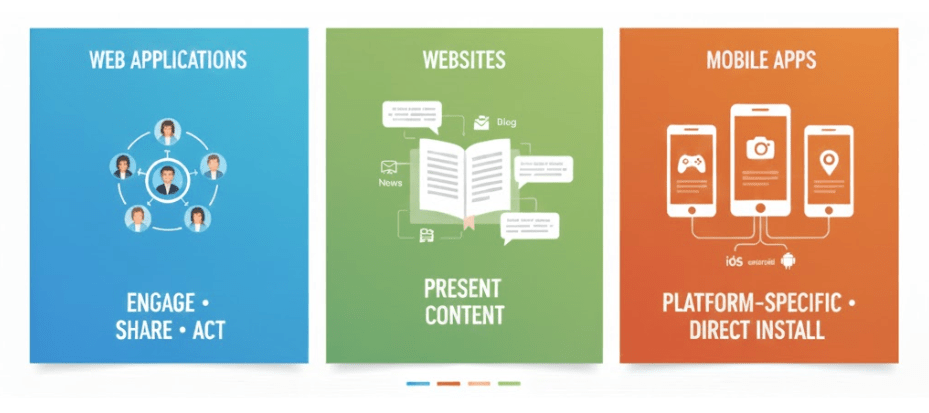
Knowing the differences is principal:
Web applications enable users to engage, share data, and carry out activities.
Websites are mainly for presenting information and content.
Mobile applications are limited to a particular platform and are directly put on devices.
Web app development is a combination of both worlds – technology is still quite usable and scalable, thus businesses get the advantage of the web’s flexibility together with the convenience of conventional software.
Why It Matters in Today’s Digital Economy
The move towards digital has made the creation of web applications a necessary business expense rather than just a technical upgrade.
1. Scalability Without Limits
Internet applications are designed to extend their services. No matter if a company has a hundred or a million users, an optimally designed web app can continue to evolve with the users’ requests.
2. Cross-Platform Accessibility
Users can utilize web apps via PCs, tablets, or mobile phones without any compatibility problems. This, on the one hand, cuts the development cost, and on the other hand, increases the number of potential users.
3. Faster Deployment and Updates
Web applications can be upgraded at the time of use. The new features, fixes, and improvements can be taken to users without their intervention.
4. Cost Efficiency
Developing and maintaining a product in a single place will lower the costs of running a business in the long term.
5. Data-Driven Decision Making
Contemporary web apps can seamlessly connect with analytics, reporting, and automation. Thus, providing businesses with the insights that can be put into action.
Key Components of Web App Development
1. Front-End Development:
The front end is the part of a product that users visually interact with and utilize. It is concerned with aspects like User Interface (UI), User Experience (UX), Responsiveness, and Accessibility. Typically, technologies such as HTML, CSS, JavaScript, and the latest frameworks like React or Angular are used.
2. Back-End Development:
The back end is in charge of the program’s logic. Its features include Data processing, Authentication and authorization, Business rules, and Server-side operations. This part of the system is accountable for reliability, performance, and security.
3. Databases:
Databases refer to places where data is stored and managed. The choice of database architecture will have the most significant impact on scalability and performance.
4. APIs and Integrations:
APIs are the tools that make it possible for different systems to communicate with each other. Web applications can be connected with third-party tools, payment gateways, analytics platforms, or internal software through the use of APIs.
5. Cloud Infrastructure & Security Architecture:
When using cloud-native methods for web app development, enterprises have the benefit of being able to deploy their apps not only on a flexible but also a scalable infrastructure. Security should not be seen as an addition; rather, it is the foundation. Web application development, from the very first day, must take into account data protection, access control, and compliance.
The Web App Development Process Explained
Although every program is different, most web application development projects follow a regulated lifecycle that aims to lessen the risk and increase the value.
1. Idea Validation and Planning
A successful web application always starts with clarity. What problem does the app solve? Who are the users? What results are expected? This phase is a business-technology match.
2. UI/UX Design
Design is more than just appearance. It concentrates on usability, user flow, and user behavior. An intuitive design will attract users and keep them.
3. Technology Stack Selection
The right technology choices will keep the app scalable, secure, and high-performing in the long run. The decisions made here will determine the app’s future.
4. Development and Testing
The developers create the app in modular components and at the same time continuous testing is done to verify the app’s stability, performance, and security.
5. Deployment and Launch
The app is installed in production environments, usually with the help of cloud-based infrastructure, thus giving it the advantages of flexibility and resilience.
6. Maintenance and Optimization
The game does not come to a finish with the launch. Performance which is guaranteed through continuous monitoring, updates, and enhancements.
Common Challenges in Web App Development
However, the development of web applications has its share of challenges, which need to be dealt with through careful planning and skilled handling.
Performance Bottlenecks
Improper architecture or code that is not efficient may cause the application to load slowly, and consequently, users will have a bad experience.
Security Vulnerabilities
Web applications have become an attractive target for hackers. If proper security measures are not taken in the development process, then at least the data that is stored will be the one that suffers.
Scalability Issues
An application that has not been designed for future growth may not cope with additional users or larger data volumes.
Misalignment With Business Goals
When business technology is created without having a clear strategy in mind, it is most likely that the resulting solutions will be neither used to their full potential nor effective.
Most of the time, confronting those problems at the very beginning of the project leads to a great improvement in the end.
Best Practices for High-Quality Web App Development
Companies need to abide by the best known practices when creating applications that can withstand crises and are ready for the future.
1. User-First Development
A user interface is supposed to be more friendly, and a real user problem should be solved by every feature.
2. Scalable Architecture
Modular, cloud-native architectures give the possibility for an application to grow without any interruption.
3. Secure-by-Design Approach
Security safeguards should be present in each stage of the development lifecycle and not be put there later.
4. Agile Development Methodology
Iterative development gives teams the possibility to teams to become very flexible, to get feedback, and to deliver continuous value.
5. Continuous Testing and Monitoring
Constant quality control is a guarantee for stability, good performance, and security during a long time.
How the Right Development Partner Makes a Difference
While the tools and technologies are important, the skill and the way of working are of even greater importance.
An effective web application development partner has just as good a grasp of the business goals as the technical requirements.
- Creates custom solutions that are perfectly aligned with the individual processes
- Emphasizes collaboration and openness
- Looks beyond immediate needs to scalability and support
Companies that put their money into seasoned development teams have the advantage of lower risks, quicker time-to-market, and more environmentally friendly digital solutions.

